The 7,100 islands of the Philippine Republic, scattered across the Pacific Ocean and South China Sea, teem with life. The entire nation is a recognized biodiversity hotspot — rated among the 17 most mega-biodiverse countries in the world — with rainforests, volcanic mountain ranges and tropical waters known for species found nowhere else on the planet.
The archipelago’s isolation for millions of years, and its wide variety of habitats has contributed to speciation across the island chain’s 300,000 square kilometers (115,831 square miles) of land area.
Species such as the Philippine eagle (Pithecophaga jefferyi), one of the largest in the world, the Sulu hornbill (Anthracoceros montani), of which fewer than 30 are thought to still exist, and the Philippine Mouse deer (Tragulus nigricans), which stands just seven inches tall, live in forests across the archipelago.
A staggering 40 percent of all bird species found in this island nation are endemic — 226 out of 569 species. Compare that to the level of avian endemism in the United States, which stands at just 7.5 percent, even though the US is more than thirty times the size of the Philippines.
BirdLife International has identified ten Endemic Bird Areas (EBAs) in the Philippines — EBAs being “the most important places for habitat-based conservation of birds” worldwide. Together those ten EBAs encompass almost the whole of the archipelago.
But these species-rich habitats, along with the unique animals that rely on them for survival, are at risk due to a legacy of extreme deforestation that is many decades old: only a fraction of primary Philippines forest is left.

A rare bird gets rarer
Among the most endangered animals are the elusive, shy, ground-dwelling Bleeding-heart doves, named for the colorful red or orange plumage that looks like an open wound blossoming on their white breasts.
All five Bleeding-heart dove species are endemic to the Philippines. Three, found on just a handful of islands, are classified as Critically Endangered by the IUCN. They’ve also been singled out by the Zoological Society of London’s EDGE of Existence program which lists them in the top 100 “Evolutionary Distinct and Globally Endangered” bird species.
Favoring closed canopy lowland forest, and foraging on the forest-floor, Bleeding-hearts are particularly hard hit when the little forest that remains to them is disturbed or cut down.
“Habitat loss from small scale logging, mining and human encroachment (agriculture and residential) are [the] main threats” to the species, revealed Juan Carlos Gonzalez, the Director and Curator for Birds at the Museum of Natural History, University of the Philippines at Los Baños. The birds are also hunted for consumption, trapped accidentally alongside other target species, and captured for sale in the pet trade. This is despite protection under Philippine law for all endangered species, with penalties ranging from fines to several years imprisonment.
For one species, the Sulu Bleeding-heart (Gallicolumba menagei) the chance for survival is slim. Fewer than 50 individuals are thought to remain on the island of Tawitawi. Even though there hasn’t been a confirmed sighting of the species since 1891, reports from the 1990s offer some hope that a small population hangs on.
It’s not only the extreme rarity of G. menagei that makes a comprehensive population assessment difficult. Accessing its most likely habitat to do a thorough survey is hampered by the “risk of bandits and insurgency,” Gonzalez said. Read the full article on Mongabay.
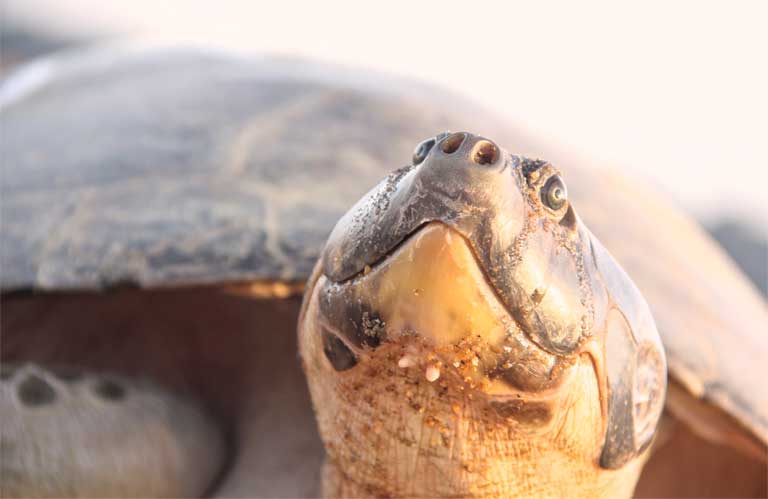 The Giant Amazon River Turtle (Podocnemis expansa) is the largest species of neotropical freshwater turtle, and is found throughout the Amazon basin. Overexploited for centuries, the species is making a comeback thanks to conservation initiatives. Photo courtesy of Camila Ferrara
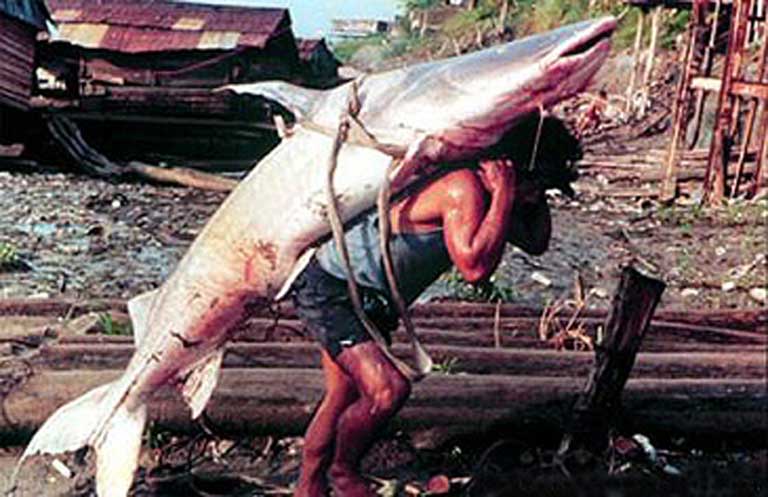 The giant Amazonian catfish is a valuable commercial species, an apex predator, and the world’s long distance freshwater fish migration record holder. Photo courtesy of the USGS Columbia Environmental Research Center.
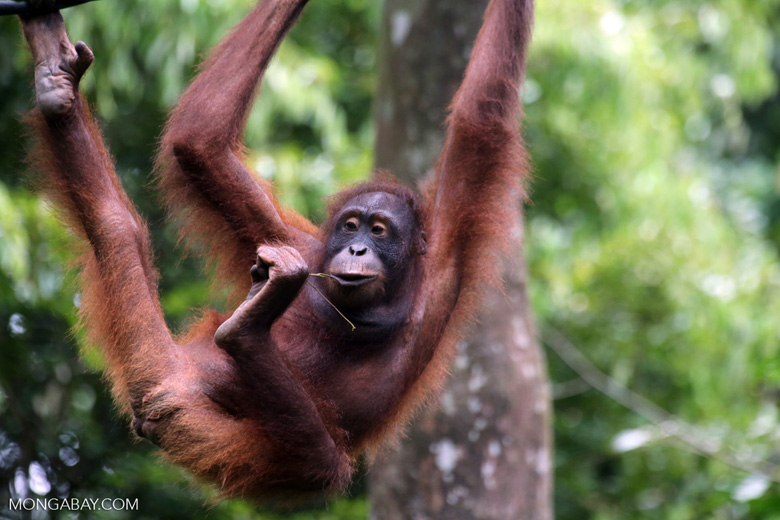 A Bornean orangutan in a rehabilitation center in Sabah. Photo by Rhett A. Butler
 River turtles in Colombia. Turtles, dolphins and otters are among the aquatic species threatened by dam construction, but risks extend to birds, bats and terrestrial animals too. Photo by Rhett A. Butler
 Rice fields in Kashmir, India. Staple crops such as rice and wheat are forecast to become less nutritious as a result of increasing carbon dioxide levels in the atmosphere. Photo courtesy of sandeepachetan.com travel photography on Flickr under CC BY-NC-ND 2.0 license
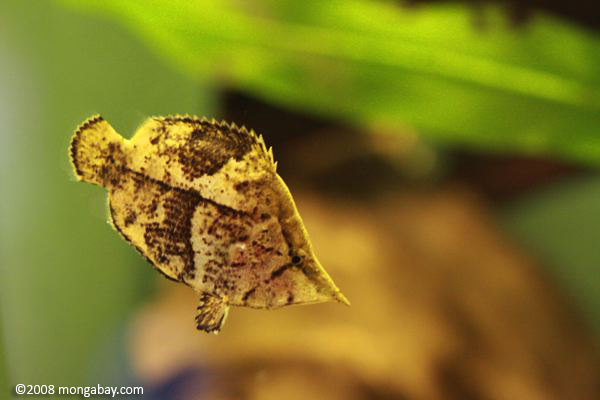 A South American Leaf Fish (Monocirrhus polyacanthus). More than 2,000 fish species live in the Amazon, the highest fish biodiversity in the world. That diversity has been greatly enriched due to the periodic isolation and intermixing of freshwater species that occurs across the region. Photo © Rhett A. Butler/Mongabay
